
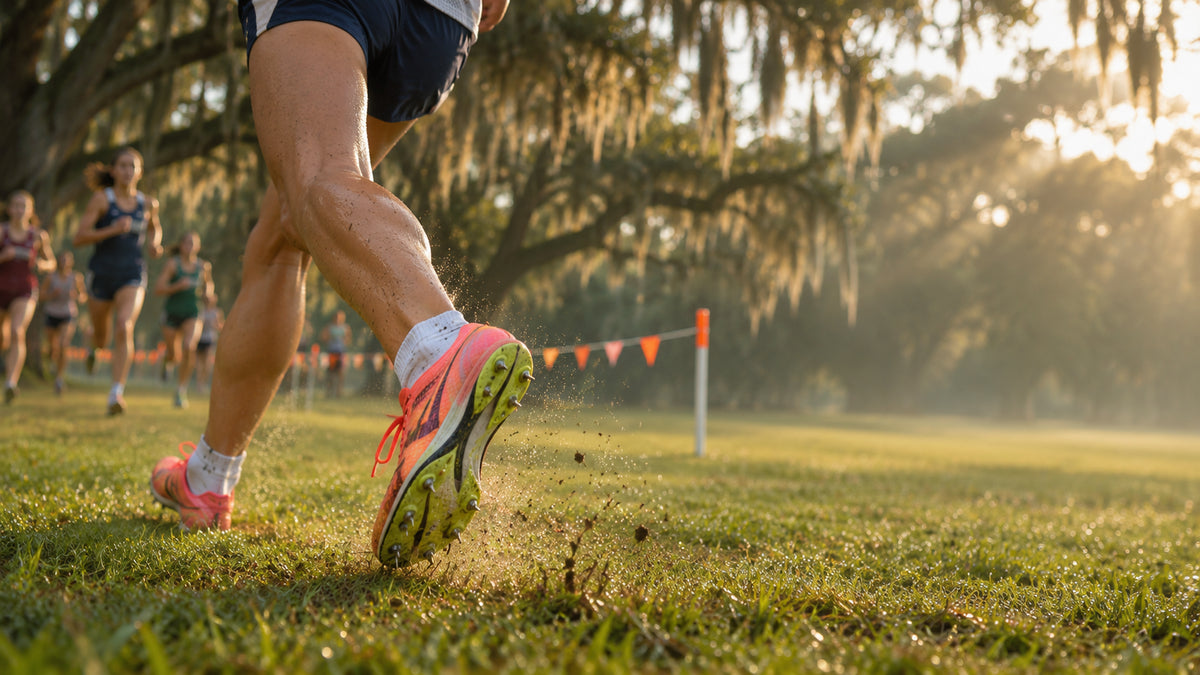
Blue Sky Endurance stocks cross country spikes for men, women and youth runners at its Mount Pleasant, South Carolina store, so you can try pairs on before race day. The staff fits XC spikes by course, distance and foot shape, not by whatever model is trending in the team group chat.
That matters in the Lowcountry. Fall courses here mix wet grass, packed sand, tree roots and low spots that turn to mud after an afternoon storm, and the wrong pin length or a loose heel costs seconds on every one of them.
This guide covers how XC spikes differ from track spikes and running shoes, which pins to use, how to size a pair and which brands are on the wall. Runners from Mount Pleasant, Daniel Island, Isle of Palms, Sullivan's Island, Awendaw and greater Charleston can use it before a store visit or before they shop online.
Key takeaways
- XC spikes are built for grass, dirt and mud over 5K, with more cushion and a tougher outsole than distance track spikes.
- Most Lowcountry courses run well on 1/4-inch pyramid pins. Save longer pins for soaked or muddy courses and check meet rules first.
- Spikes should fit snugger than daily trainers, with a small gap at the toe and no heel slip.
- Blue Sky Endurance carries Nike, Adidas and On Running spikes and racing shoes in men's, women's and unisex sizing.
- A pair usually lasts one to two seasons when you save it for meets and workouts and do your mileage in regular running shoes.
How XC spikes differ from track spikes and running shoes
Cross country spikes are light racing shoes with a spike plate under the forefoot, made for off-road courses. They sit between distance track spikes and everyday running shoes in cushion, stiffness and grip.
Here is how the four shoe types compare:
- XC spikes have a flexible plate, a textured rubber heel for grip on grass and hills, and a little more foam for 5K of uneven ground.
- Distance spikes have a stiffer plate and less heel material. They are made for the 1600m, 3200m and 5000m on a track.
- Lightweight sprint spikes have rigid, aggressive plates that keep you up on your toes. They are the wrong tool for a hilly 5K.
- Running shoes handle daily mileage, easy days and warmups. They protect your legs during the week so your spikes stay fresh for race day.
Some athletes race cross country in spikeless cross country racing shoes, especially middle schoolers or runners on hard, dry courses. Our staff can show you both options and how each one grips the ground.
Choosing spike pins for Lowcountry courses
Pin length depends on the ground, and Charleston-area courses change with the weather. A dry September course can feel firm, while the same loop after a week of rain holds standing water.
Use this order when you set up a new pair:
- Start with 1/4-inch (6mm) pyramid pins. They grip grass and packed dirt and suit most local high school courses.
- Move to 3/8-inch (9mm) pins for soft, wet or muddy footing, or for steep grass hills.
- Use 1/2-inch (12mm) pins only for deep mud, and only if meet rules allow them.
- Ask your coach about pin limits before race day, since some meets cap length or route runners over paved paths.
- Keep a spike wrench and a few spare pins in your bag. Pins loosen during a season, and a missing one can damage the threads in the plate.
Most South Carolina high school cross country races cover 5K, and middle school races are shorter. Over that distance, a spike that is too stiff or too heavy wears on your calves in the final mile, so comfort counts as much as grip.
Walk to the start line in your trainers and change into spikes at the team tent. Pavement and sidewalks dull pins fast and can crack the plate.
Spike brands at Blue Sky Endurance
Blue Sky Endurance carries XC spikes and racing shoes from Nike, Adidas and On Running. Inventory turns over during the season, so the cross country spikes collection shows current models, sizes and price before you drive over.
- The Nike XC lineup has included the Zoom Rival XC, a durable pair for first-year runners, and the Dragonfly XC, a lighter racing option. Nike also makes distance spikes for spring track.
- Adidas spikes such as the Adizero XCS pair grip with a light upper, and many styles come in unisex sizing.
- On Running makes spikes and racing shoes with a firm, quick ride that many runners like for faster workouts and race day.
Most spikes are sold in men's or unisex sizing. Women usually convert by going about 1.5 sizes down from their women's size, and our fit team checks that conversion on your foot.
Working with a budget? Ask the store whether last season's colors are on clearance, since closeout spikes can bring the price down without giving up much performance.
How to buy XC spikes that fit
A spike should feel like part of your foot. It fits snugger than a trainer because it has to stay locked down on turns, hills and muddy footing.
Follow these steps at the store:
- Bring the socks you race in. Thin running socks fit very differently than thick cotton pairs.
- Shop in the afternoon or after a run, when your feet are slightly larger.
- Ask staff to measure length and width on both feet. Sizing varies between brands and even between models from the same brand.
- Leave a small gap at the toe, about a quarter of a thumb's width, and check for heel slip on a short jog.
- Try at least two pairs side by side. Spikes should feel good on day one, since they do not need to be broken in.
Youth runners grow fast, so parents should ask about fit for the full season. A pair that fits in August may pinch by the championship meets in November.
You can read a hundred reviews online, but none of those reviewers have your feet. Owner Catherine Hollister and the Blue Sky Endurance team have fit Lowcountry runners for 10 years, and certified pedorthist Carolyn from The Foot Store helps athletes with foot pain or hard-to-fit feet.
Gear to pack with your spikes
Spikes are one piece of a race-day bag. Training shoes, apparel and recovery gear help runners show up healthy for every meet on the fall schedule.
- Daily trainers from our men's shoes and women's shoes handle mileage and warmups, including Mount to Coast models built for long training runs.
- Oofos recovery footwear is easy to slip on after the race, when feet and calves are sore.
- Running apparel from men's apparel and women's apparel covers singlets and shorts plus layers for cool fall mornings and winter training.
- Thin running socks, a spike bag and GPS watches sit in electronics and accessories.
Training with other runners makes the season easier. Blue Sky Endurance hosts free group runs, clinics and local races, listed on the community page, and the run shop covers everything else for running.
Cross country spikes FAQs
Can you wear cross country spikes for track and field?
Yes, cross country spikes work for distance track events like the 1600m and 3200m. They have more cushion and a softer plate than distance track spikes, so they feel a bit slower on the oval. Swap to short track pins and check the facility's pin limit first.
How long do cross country spikes last?
Most cross country spikes last one to two seasons when you wear them only for meets and some workouts. Replace them when the plate cracks, the pin threads stop holding or the upper stretches and your foot slides.
What is the difference between distance track spikes and cross country spikes?
Distance track spikes have a stiffer plate and very little heel material for a flat, fast surface. Cross country spikes add a tougher outsole, heel grip and extra foam for grass, dirt and hills over 5K.
What is the best size spikes for cross country?
For pins, 1/4-inch pyramids handle most courses, and 3/8-inch pins help in mud or on steep wet grass. For shoe size, expect a snugger fit than your trainers, and have staff measure since sizing changes by brand.
Where can I buy cross country spikes in Mount Pleasant?
Blue Sky Endurance in Mount Pleasant, South Carolina sells cross country spikes for men, women and youth runners, with in-store fitting. Runners in Charleston, Daniel Island and nearby towns can also shop the full collection online.
Get your spikes before the next meet
The right XC spikes grip the course, hold your heel and let you race the last mile instead of fighting your shoes. Visit Blue Sky Endurance in Mount Pleasant to try several pairs, or order today and pick the race-day setup that fits your season.
- Shop cross country spikes for fall racing.
- Shop track spikes for distance events this spring.
- Shop training shoes for men and women.
- Add socks, a watch and race-day extras from electronics and accessories.
Bring your race socks and your course schedule, and our team will help you choose the pair and pins that match both.